
- SMB Jugaad
- December 12, 2025
- Business

By Srinivas GRK 👉
On a quiet Tuesday afternoon in Portland, Oregon, Claire — owner of a 20-year-old family-run clothing boutique — stared at her register, wondering how much longer her shop could survive. Foot traffic had slowed. Younger shoppers browsed her website but rarely visited the store. Online competitors offered fast shipping, huge selections, and aggressive discounts she simply couldn’t match.
Her loyal customers still came… but not often enough.
One evening, at a local business owners meet-up, a fellow retailer told her,
“You can’t out-discount e-commerce — but you can out-personalize them with AI.”
Intrigued, Claire implemented a handful of AI tools:
→ AI-powered personalized recommendations
→ AI-driven foot-traffic forecasting
→ Smart inventory planning
→ AI-enhanced local marketing
→ An AI sales assistant on her website
Within months, she saw changes she didn’t think were possible:
- Repeat customers doubled
- Inventory turnover improved
- Foot traffic increased
- Local shoppers discovered her store for the first time
- Her in-store experience became more personalized than Amazon
Claire says today:
“AI didn’t replace what made my business special. It amplified it.”
Across the United States, brick-and-mortar businesses — from boutiques and salons to grocery stores and hardware shops — are discovering the same truth:
AI is the competitive advantage that allows physical stores to thrive in an e-commerce world.
Why U.S. Brick-and-Mortar Stores Struggle Against E-Commerce
Physical stores face challenges e-commerce doesn’t:
- High overhead costs
- Limited inventory
- Labor shortages
- Regional restrictions
- Smaller marketing budgets
- Inconsistent foot traffic
- Lower data visibility
E-commerce platforms win with:
✔ Convenience
✔ 24/7 availability
✔ Personalized recommendations
✔ Massive data insights
✔ Aggressive pricing
✔ Nationwide reach
But brick-and-mortar stores have what e-commerce lacks:
- Human service
- Tangible experience
- Instant fulfillment
- Hyper-local trust
AI helps physical stores maximize these advantages while solving their weaknesses.
How U.S. Brick-and-Mortar Businesses Compete with E-Commerce Using AI
Below is a complete breakdown of how AI levels the playing field for offline businesses.
1. AI-Powered Personalization That Beats Online Stores
E-commerce thrives on personalization.
Now, AI gives physical stores that same power — and more.
AI Personalization Tools Offer:
✔ product suggestions based on purchase history
✔ tailored in-store recommendations
✔ personalized promotions via SMS/email
✔ browsing-to-in-store conversion
✔ smart loyalty rewards
“The lead generation process starts by finding out where your target market ‘lives’ on the web.” – Wayne Davis
Why It Works for Brick-and-Mortar
Customers love feeling understood.
AI empowers associates to offer Amazon-level personalization — but with warmth and human interaction.
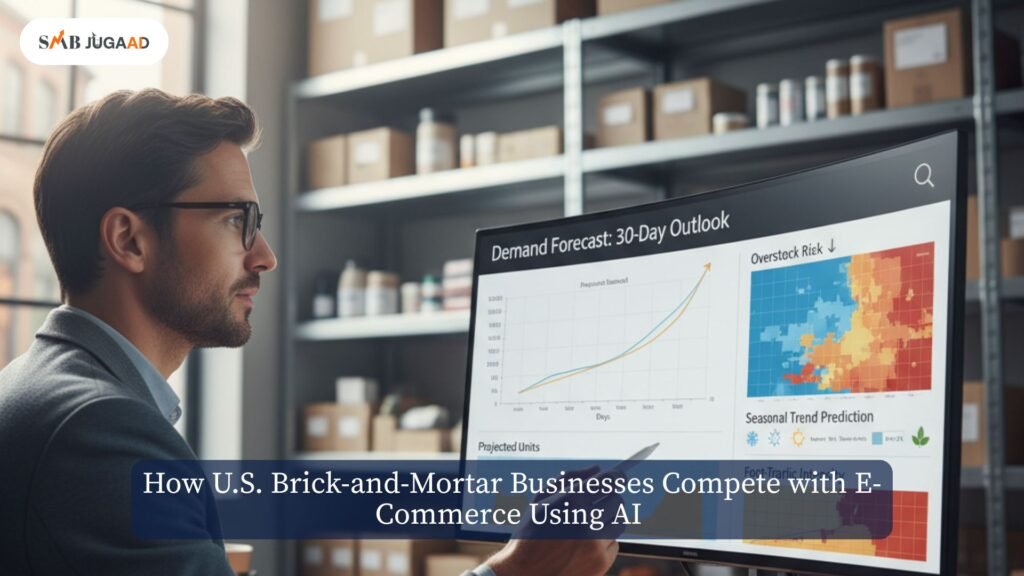
2. AI Demand Forecasting for Better Inventory & Avoiding Stockouts
E-commerce warehouses rely heavily on forecasting.
Now local stores can too.
AI Predicts:
- which products will surge
- which will slow
- seasonal trends
- local weather impact
- foot-traffic patterns
- holiday demand
Impact on Local Stores
✔ fewer overstock issues
✔ fewer stockouts
✔ better cash flow
✔ smarter ordering
✔ reduced waste
This makes stores more competitive with online giants that rarely run out of products.
3. AI Marketing That Targets Local Shoppers More Precisely Than Online Ads
E-commerce platforms run national campaigns.
Brick-and-mortar stores need local relevance.
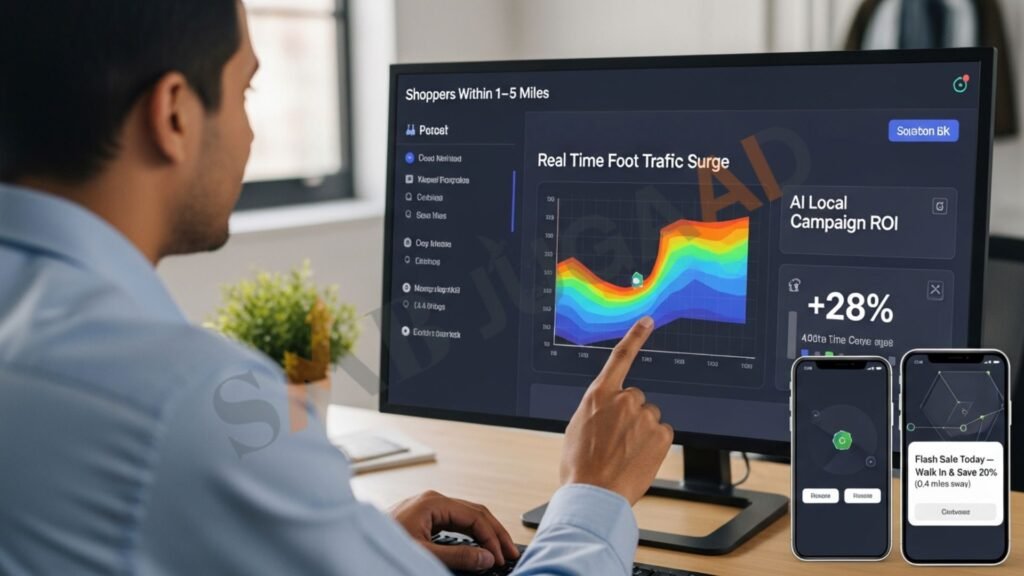
Predictive AI marketing identifies:
✔ who lives within 1–5 miles
✔ who recently searched for your products
✔ who visited your website
✔ who attended nearby events
✔ local shoppers passing by with purchasing intent
Local targeting outperforms generic e-commerce ads.
4. AI Automates Customer Follow-Ups & Increases Repeat Visits
Online stores excel at automated retention.
Physical stores historically suffer here — but not anymore.
AI automatically sends:
- personalized offers
- VIP rewards
- replenishment reminders
- back-in-stock alerts
- appointment reminders
- seasonal messages
This increases repeat shopping frequency by 20–40%.
5. AI Enhances In-Store Experience (A Major Advantage Over Online Shopping)
AI transforms the physical shopping journey:
Examples
- Smart fitting rooms showing available sizes/colors
- Mobile checkout recommendations
- AI-guided store maps (“Where’s the gluten-free aisle?”)
- Touchscreen product explorers
- Voice assistants explaining product features
- AI kiosks recommending outfits, recipes, or pairings
These experiences make physical stores more exciting than clicking through a website.
6. AI Helps Staff Perform Like Top Salespeople
Small stores often don’t have highly trained staff.
AI assistants provide on-the-spot:
✔ product knowledge
✔ upsell suggestions
✔ cross-sell ideas
✔ customer preference insights
✔ pricing & promotion data
Even part-time employees can provide world-class service.
7. AI Enables Dynamic Pricing (Just Like E-Commerce)
AI analyzes:
- competitor prices
- market demand
- regional purchasing power
- inventory levels
- customer behavior
Then it recommends the perfect in-store price.
Brick-and-mortar stores can finally flex pricing the way Amazon does.
8. AI Integrates Online + Offline for Omnichannel Advantage
The best-performing U.S. retailers blend channels:
AI enables:
✔ buy-online-pickup-in-store (BOPIS)
✔ cart recovery + in-store incentives
✔ QR code experiences
✔ digital loyalty linked to in-store purchases
✔ in-store browsing → online checkouts
This removes friction and boosts conversions.
Real U.S. Case Studies: AI Helping Brick-and-Mortar Compete
Case Study 1: Clothing Boutique (Oregon)
Problem: Declining foot traffic
AI Solution: Predictive marketing + local targeting
Results:
- 28% increase in store visitors
- 19% boost in weekend sales
Case Study 2: Grocery Store (Texas)
Problem: Overstock & spoilage
AI Solution: AI demand forecasting
Results:
- 45% reduction in waste
- 22% higher profit margins
Case Study 3: Salon Chain (Florida)
Problem: High no-shows & poor retention
AI Solution: AI appointment reminders + personalized offers
Results:
- No-shows dropped 30%
- Repeat visits increased 35%
Case Study 4: Local Bookstore (New York)
Problem: Competing with Amazon
AI Solution: Personalized recommendations + AI restocking
Results:
- 32% increase in repeat customers
- Stockouts cut in half
Case Study 5: Hardware Store (Ohio)
Problem: Seasonal demand unpredictability
AI Solution: Weather-integrated demand forecasting
Results:
- Sold out seasons reduced to 0%
- Predictable inventory cycles
Why AI Gives Brick-and-Mortar Stores a Unique Competitive Edge
-
1. The Human Experience + AI Efficiency
Something e-commerce cannot replicate.
-
2. Hyper-Local Understanding
Your neighborhood — not the entire country.
-
3. Faster Adjustments
You can change store layout, promotions, and service instantly.
-
4. Higher Trust
Local businesses are deeply valued by communities. AI amplifies these advantages while fixing operational weaknesses.
Conclusion
AI is not replacing brick-and-mortar businesses — it’s reviving them.
With the right AI-powered strategies, physical stores can:
✔ out-personalize online competitors
✔ improve margins
✔ offer superior experiences
✔ attract more foot traffic
✔ predict demand
✔ retain customers longer
In 2026 and beyond, the most successful stores will not be the ones with the biggest budgets — but the ones using AI the smartest.
For U.S. brick-and-mortar businesses, AI is the new competitive edge.
“If people like you, they’ll listen to you, but if they trust you, they’ll do business with you.” – Zig Ziglar
Also Read: AI Ethics for Small Medium Business: How to Protect Your Customers and Build Trust in 2025
FAQs
Is AI expensive for brick-and-mortar stores?
Can AI help small shops with limited staff?
Do physical stores need technical skills to use AI?
How fast does AI improve store sales or foot traffic?
Does AI replace employees?
By Srinivas GRK
Srinivas GRK is the Founder of SMBJugaad LLC and a Cloud, AI, and Oracle Expert with over two decades of experience in technology and digital transformation. He’s passionate about helping small and mid-sized businesses leverage AI, Cloud, and smart automation to scale faster. You can connect with Srinivas on LinkedIn