
- SMB Jugaad
- December 5, 2025
- Business

By Srinivas GRK 👉
Late one Thursday evening in Houston, Maya — a sales manager for a small B2B technology firm — stared at her CRM dashboard with growing frustration. Her team had spent weeks chasing leads, sending proposals, hosting demos, and following up. Yet the pipeline kept shrinking. Deals stalled. Prospects suddenly went silent. Some leads she thought were strong just weren’t converting.
What bothered her most wasn’t the rejection — it was the unpredictability.
One of her top reps, Jordan, closed a major deal seemingly out of nowhere… while another rep lost a promising prospect despite giving three demos.
Maya felt like she was managing sales through guesswork, not strategy.
Then a colleague introduced her to predictive analytics for sales. Within weeks, everything changed.
The system analyzed every past deal, email open, buying signal, follow-up delay, and behavior pattern. Suddenly, Maya could see exactly which leads were ready to close. Which ones needed nurturing. Which ones were a waste of time.
By the end of the quarter, her close rate jumped 33%, follow-ups became strategic, and for the first time in years — Maya felt in control of her sales pipeline.
Across the United States, thousands of businesses are discovering the same truth:
Predictive analytics isn’t just data — it’s the power to close more U.S. deals faster and smarter.
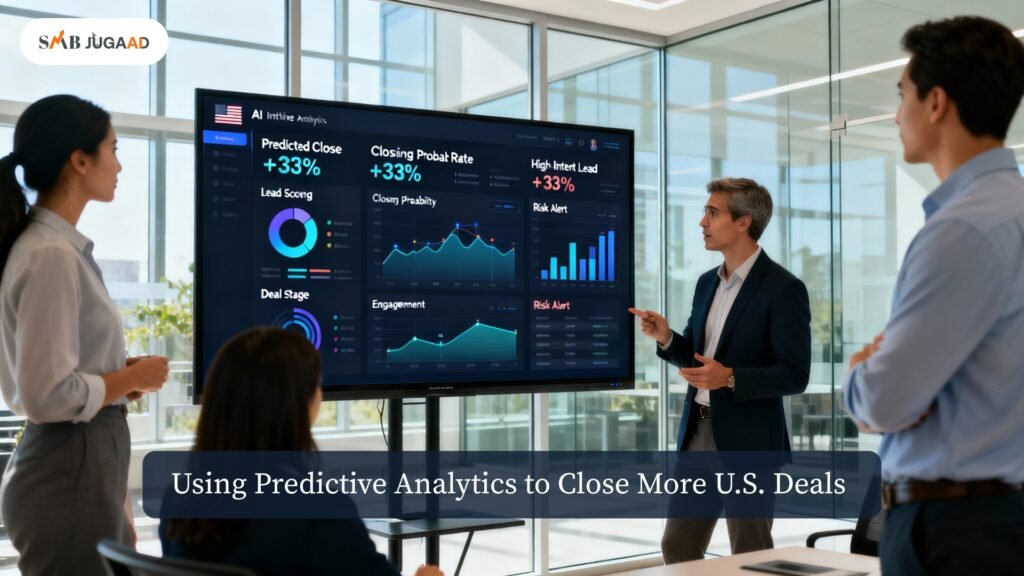
Why Predictive Analytics Is Transforming Sales in the U.S.
Small and medium businesses across the U.S. face enormous pressure in 2026:
- Rising customer acquisition costs
- Complex buyer journeys
- Price competition
- Slower response times
- Information overload
- Pipeline uncertainty
Traditional sales methods aren’t enough anymore.
You can’t rely only on instincts, cold lists, or simple CRM scoring.
Predictive analytics changes everything by using data patterns to predict:
- Which leads will close
- When they will close
- Why they will close
- Which deals need attention
- Which prospects are disengaging
- Which outreach timing works best
- What objections might arise
It eliminates guesswork and gives your sales team a science-backed roadmap for success.
What Is Predictive Analytics in Sales?
Predictive analytics uses:
- Machine learning
- Historical sales data
- Lead behavior
- Website interactions
- Email engagement
- Market trends
- Demographics
- Past deals
- Competitor movement
… to forecast the likelihood of a lead converting into a paying customer.
Put simply:
👉 Predictive analytics tells you which deals you are most likely to win — and what to do next to close them.
For U.S. sales teams, it’s like having a smart assistant that understands your entire sales history and predicts outcomes you would otherwise miss.
How Predictive Analytics Works (Step-by-Step)
Data Collection From Multiple Sources
Predictive analytics pulls data from:
Internal Business Data
- CRM (HubSpot, Salesforce, Zoho)
- Email engagement (opens, clicks, replies)
- Website analytics
- Landing page activity
- Social interactions
- Past deals
- Demo participation
- Buying history
- Lead demographics
- U.S. market trends
This creates a 360-degree view of your prospect.
Behavioral Pattern Analysis
AI analyzes behavior patterns like:
- Response speed
- Email sentiment
- Time spent on your website
- Viewed products/services
- Follow-up intervals
- Proposal download activity
- Pricing page visits
- Demo participation
From this, it identifies “ready to buy” signals.
Lead Scoring Using Machine Learning
Predictive lead scoring assigns each lead a “likelihood to close” score based on:
- Historical win/loss data
- Industry trends
- Engagement signals
- Budget fit
- Company size
- Timeline indicators
Example:
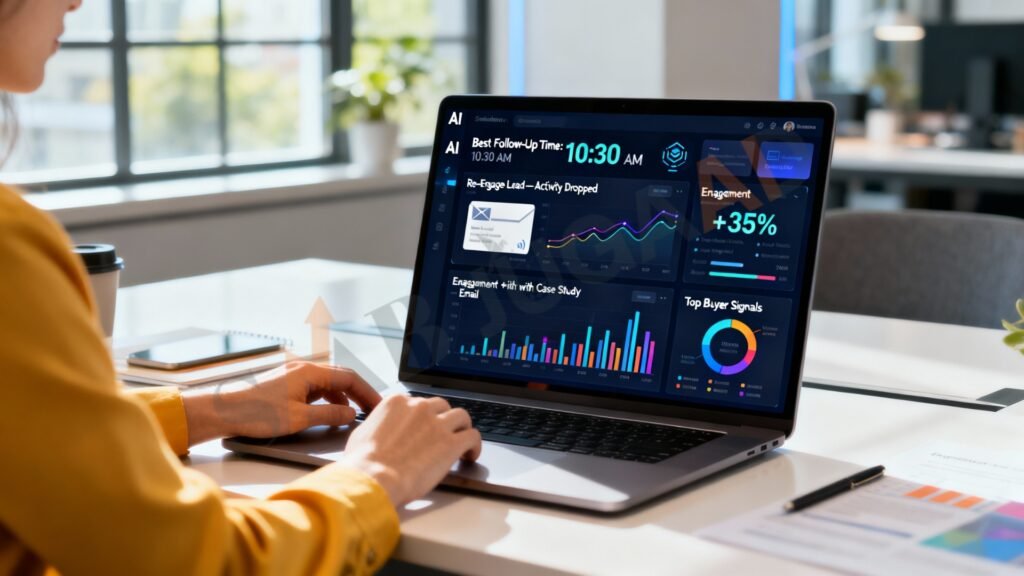
A lead who opens 4 emails, downloads a case study, and revisits pricing pages may score 92/100 — indicating high closing potential.
Deal Outcome Predictions
The system predicts:
- Probability of closing
- Expected close date
- Estimated deal value
- Risk factors
- Objections likely to arise
- Competition threats
It even tells you why the prediction is made.
“With data collection, ‘the sooner, the better is always the best answer.” — Marissa Mayer
Also Read: AI Ethics for Small Medium Business: How to Protect Your Customers and Build Trust in 2025
Recommended Next Actions
Predictive analytics doesn’t stop at insights — it prescribes actions, such as:
- “Send a follow-up email within 2 hours”
- “This lead responds best to morning outreach”
- “Schedule a demo to increase close probability”
- “Discount not required — high purchase intent detected”
- “Prospect comparing competitors — share case studies”
Your sales reps no longer rely on guesswork.
Continuous Optimization
Every new deal — win or loss — trains the algorithm to get smarter over time.
How Predictive Analytics Helps Close More U.S. Deals
Identifies High-Intent Leads Instantly
No more treating all leads equally.
Predictive analytics highlights:
- Who is ready to buy
- Who needs nurturing
- Who is unlikely to convert
Sales teams focus on the right opportunities — instantly increasing close rates.
Prevents Lead Drop-Off
AI identifies at-risk leads and alerts you before it’s too late.
You can re-engage them before they disappear.
Reduces Follow-Up Mistakes
Predictive analytics shows:
- Optimal follow-up timing
- Best outreach channel
- Ideal messaging style
This keeps prospects engaged.
Personalizes Sales Conversations
AI uncovers:
- Buyer interests
- Pain points
- Budget indications
- Previous behavior
Sales reps speak directly to what the buyer cares about — making deals easier to close.
Shortens the Sales Cycle
When you know exactly what a prospect needs and when they’re ready:
- Fewer calls
- Faster decision-making
- Quicker deal closures
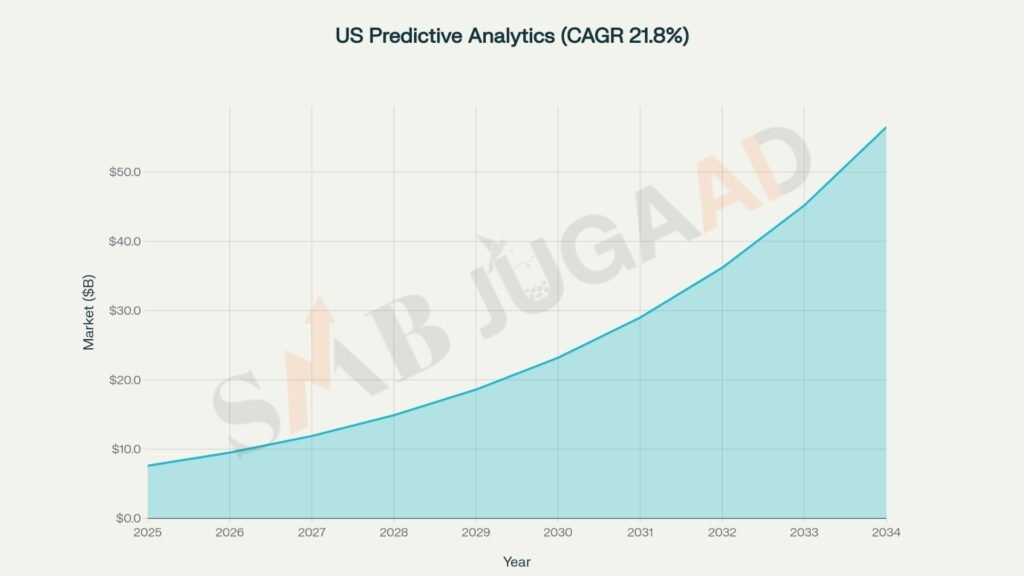
Improves Forecast Accuracy
Instead of vague forecasts, you get:
- Precise revenue predictions
- Pipeline health indicators
- Deal probability percentages
U.S. investors, managers, and teams rely on accurate forecasting.
Helps Sales Teams Prioritize Smartly
Reps no longer chase “busy but not buying” prospects.
They focus on high-probability wins, boosting productivity and morale.
Real U.S. GEO Examples (2026)
-
California — SaaS Startups
Predictive analytics identifies churn risk, upsell opportunities, and high-intent demo users.
-
Texas — Real Estate Brokerages
Predicts which buyers are financially ready and which listings will move fastest.
-
Florida — Healthcare & Wellness Providers
Predicts appointment-booking patterns and referral behavior.
-
New York — B2B Service Agencies
Identifies warm leads, peak buying seasons, and deal drop-off risk.
-
Illinois — Restaurants & Bakeries
Predicts wholesale order timing, seasonal demand, and reorder cycles.
Conclusion
Predictive analytics is no longer reserved for Fortune 500 companies.
Today, even a small U.S. consultancy, real estate office, or retail store can use AI
Just like Maya’s team in Houston, any U.S. business can transform their sales pipeline by replacing guesswork with clarity.
In 2026 and beyond, the companies that close the most deals will be the ones that predict buyer behavior — not react to it.
“When we started Pixar, I was really in over my head. But I look at being in over my head as a feature, not a bug.”— Ed Catmull
Is predictive analytics expensive?
Do I need a data team?
Which tools offer predictive analytics?
Can predictive analytics work with my CRM?
Does predictive analytics really increase close rates?
By Srinivas GRK
Srinivas GRK is the Founder of SMBJugaad LLC and a Cloud, AI, and Oracle Expert with over two decades of experience in technology and digital transformation. He’s passionate about helping small and mid-sized businesses leverage AI, Cloud, and smart automation to scale faster. You can connect with Srinivas on LinkedIn