
- SMB Jugaad
- November 17, 2025
- Business

By Srinivas GRK 👉
AI Myths For Small Businesses 2025
In early 2025, at a Chamber of Commerce breakfast event in Phoenix, business owners gathered around coffee and pastries discussing a familiar topic: AI.
A boutique retail owner said, “AI sounds powerful, but that’s for big brands, right?”
A family-run dental clinic owner added, “I’m worried AI will make us look robotic.”
A construction contractor shook his head and whispered, “Even if I wanted to use it, I don’t have the budget or technical skills.”
A consultant sitting nearby quietly opened her laptop and showed them something unexpected: local bakeries using AI to reduce ingredient waste, HVAC companies automating scheduling, therapists using AI to streamline billing, and restaurants using AI to send personalized offers to repeat customers.
The room fell silent.
The problem wasn’t ability.
The problem was beliefs — assumptions holding back growth.
This article addresses those beliefs head-on.
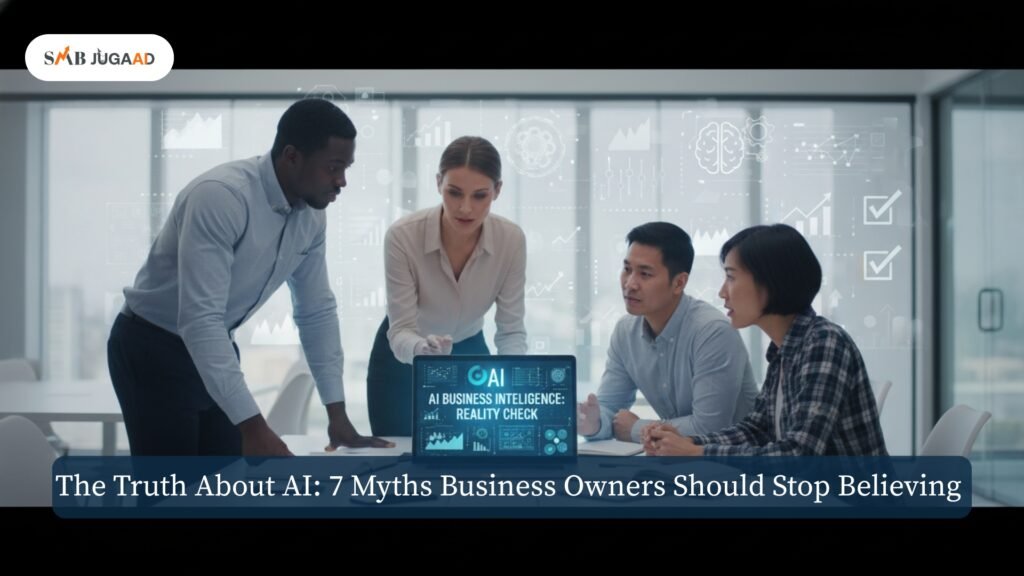
AI Has Shifted — But Many Perceptions Have Not
AI has evolved dramatically. Tools that previously required data scientists and enterprise budgets are now:
- Affordable
- Easy to use
- Built for non-technical business owners
- Integratable into familiar platforms (CRM, booking tools, SMS, email, POS)
Yet, outdated assumptions linger — creating hesitation, fear, and inaction.
The result?
Small businesses fall behind competitors — not because AI is out of reach, but because myths prevent adoption.
Myth #1: “AI Is Only for Large Corporations.”
This is the most common belief — and also the most outdated.
Why the Myth Exists
Historically, AI required:
- Data engineers
- Cloud infrastructure
- Custom algorithm training
- Large-scale datasets
- Millions in R&D budgets
Enterprises had this. Small businesses did not.

Why It’s No Longer True
In 2025, the AI landscape transformed. Tools now include:
| Type of AI Tool | Examples | SMB Use Case |
|---|---|---|
|
AI Customer Service Bots |
Intercom, Tidio, ChatGPT-based bots |
Respond to inquiries instantly |
|
AI Sales & CRM |
HubSpot AI, Zoho AI, Pipedrive Smart AI |
Lead scoring & follow-ups |
|
AI Marketing |
Jasper, Canva AI, Copilot |
Social posts, emails, ads |
|
AI Scheduling & Admin |
Calendly AI, Zapier AI |
Workflow automation |
No coding. No IT department.
Real Example
A local pet grooming shop in Ohio implemented an AI appointment scheduler.
- Saved 9 hours/week of admin call
- Increased weekly bookings by 18%
- Zero technical background required
Reality: AI has become SMB-first, not enterprise-first.
Focus Keyword Placement: This myth persists because many small businesses lack exposure to the real capabilities of AI Myths for Small Businesses, not because the technology is inaccessible.
Myth #2: “AI Is Too Expensive.”
This belief comes from comparing AI to employees, not tools.
Cost Comparison
| Solution | Cost | Limitation |
|---|---|---|
|
Hiring a receptionist |
~$3,500/mo |
Business hours only |
|
Hiring a marketing agency |
$1,000–$6,000/mo |
Often slow turnaround |
|
Hiring a data analyst |
$5,000+/mo |
Rarely feasible for SMBs |
|
AI Tools |
$19–$99/mo |
Available 24/7, scalable |
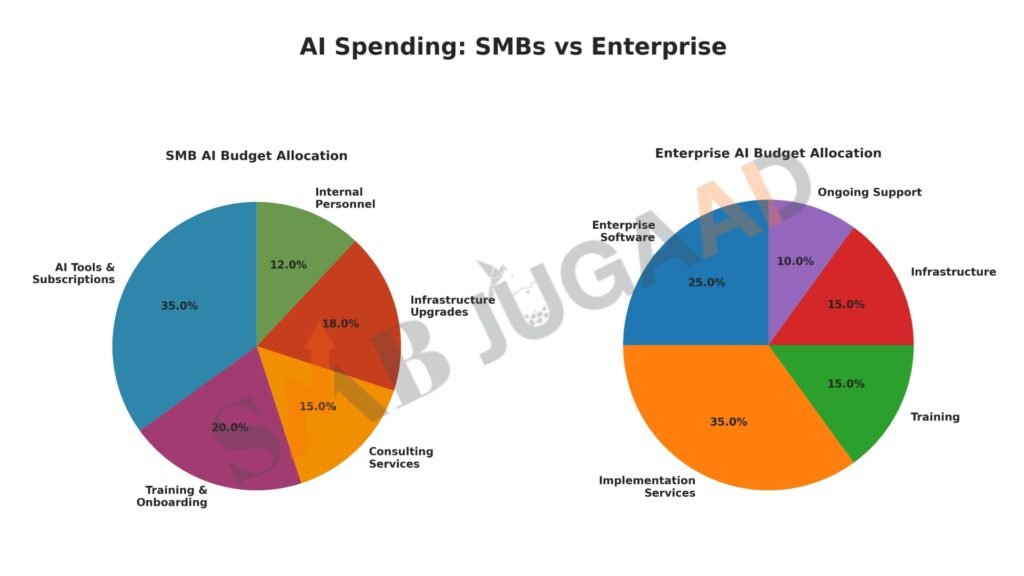
Why AI Reduces Cost
AI automates:
- Appointment coordination
- Lead qualification & follow-ups
- Customer intake questions
- Simple support replies
- Invoice reminders
- Inventory planning
This eliminates waste — the hidden drain on SMB margins.
Case Example
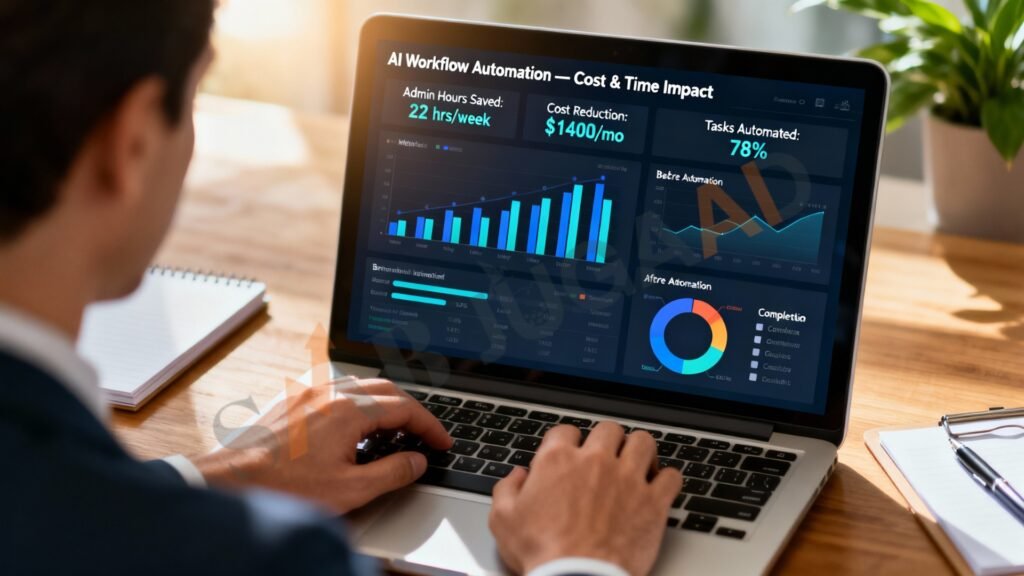
A Miami-based home cleaning company replaced manual client onboarding with an AI-driven intake chatbot.
Monthly savings: $1,400
Time recovered: 22 hours/week
Customer satisfaction: +27% (due to faster response time)
Reality: AI is cheaper than part-time staff — and never calls in sick.
Myth #3: “You Need Technical Skills or Coding Knowledge.”
Why This Feels True
Technology terms often sound intimidating:
- Neural networks
- Predictive inference
- Model tuning
- Workflow orchestration
These imply complexity.
“Don’t worry about failure. You only have to be right once.” -Drew Houston,
Modern AI Tools Are Built for Simplicity
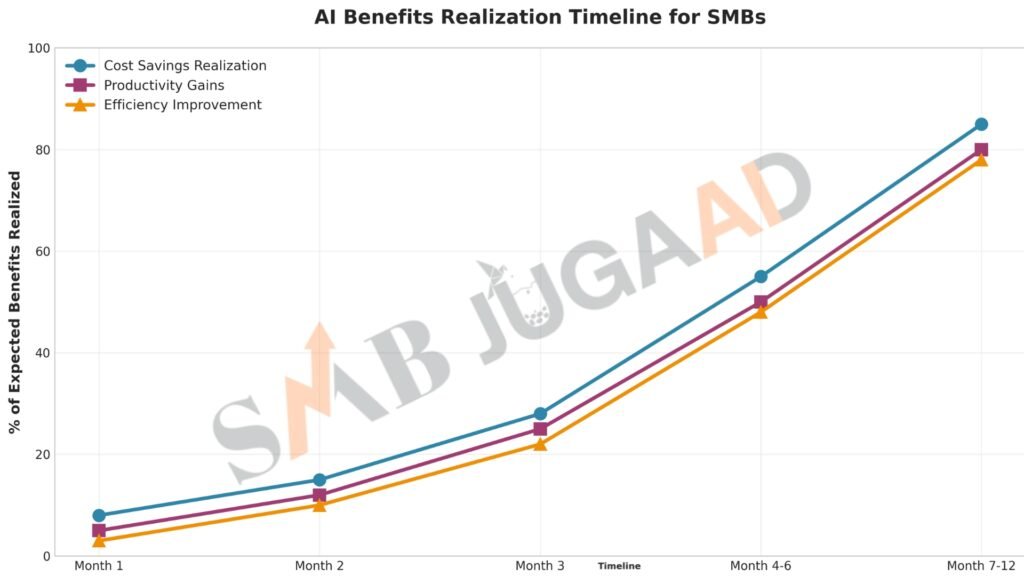
Current platforms offer:
- Drag-and-drop automation templates
- “Write in plain English” prompt interfaces
- Guided setup wizards
- YouTube-level onboarding tutorials
If you can:
- Use WhatsApp
- Copy-paste text
- Upload a document
You can use AI.
Example
A 62-year-old spa owner in San Diego, with zero software background, implemented AI-driven monthly membership reminders.
Setup time: 1 hour
Revenue increase: +12% recurring monthly sales
Reality: The barrier is not ability — it is confidence.
Myth #4: “AI Will Replace My Employees.”
Clarification
AI replaces tasks, not people.
| AI Handles | Humans Handle |
|---|---|
|
Repetitive questions |
Emotional connection |
|
Data entry
Scheduling
|
Negotiations
Trust-building
|
|
First-response support |
Service recovery |
AI makes employees more effective, not unnecessary.
Operational Impact
Instead of 6 staff doing low-value tasks →
2-3 staff focus on revenue-driving actions.
Case Example
A dental office in Charlotte introduced an AI assistant for appointment reminders.
Reception workload dropped by 35%.
But no one was fired.
Staff gained time to improve patient care and retention.
Reality: AI strengthens teams by freeing them to do higher-value work.
Myth #5: “AI Will Make My Business Feel Less Personal.”
The Underlying Fear
Small businesses win by being:
- Friendly
- Local
- Human
- Relationship-driven
Owners fear AI removes this identity.
What Actually Happens
AI handles efficiency.
Humans handle empathy.
Together, they create:
- Faster service
- Personalized messaging
- Better memory of customer history
- Deeper loyalty retention
Example
A boutique fitness studio in Austin uses AI to:
- Remember customer preferences
- Send personalized encouragement after missed classes
- Recommend class types based on performance trends
People imagine a long IT project.
“To be successful, you must act big, think big and talk big.” -Aristotle Onassis,
Myth #6: “AI Takes Too Long to Set Up.”
Misconception
People imagine a long IT project.
Modern Reality
AI deployment can happen in 24–72 hours, when done incrementally.
Implementation Framework
| Phase | Duration | Outcome |
|---|---|---|
|
Phase 1: Automate FAQs |
1–2 days |
Instant support |
|
Phase 2: Automate scheduling & reminders |
3–7 days |
Reduce admin workload |
|
Phase 3: Automate marketing workflows |
2–4 weeks |
Consistent lead nurturing |
Myth #7: “AI Will Solve All Problems Automatically.”
AI is powerful.
But AI is not magic.
AI Needs:
- A clear workflow
- Defined outcomes
- Business logic
- Team adoption
AI Works Best When:
- Train your staff
- Refine workflows
- Adjust systems monthly
- Monitor real usage
- Fix breakdowns quickly
Strategic Truth
AI is amplification.
If your business is structured well → AI accelerates growth.
If workflows are broken → AI amplifies confusion.
The Strategic Opportunity for SMBs in 2025
Businesses that adopt AI early gain:
- Faster response times
- Higher retention
- Stronger margins
- More predictable revenue
- Lower burnout among staff
- Better customer satisfaction scores
Businesses that delay risk:
- Falling behind competitors
- Reduced operational efficiency
- Increasing cost of manual work
- Customer frustration due to slow response times
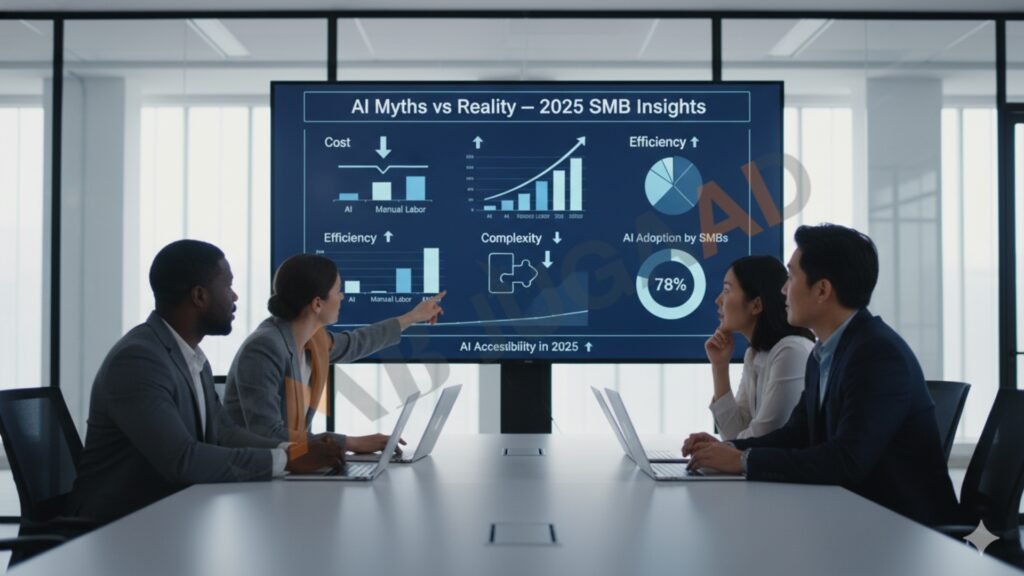
AI adoption is no longer advantage — it is necessity.
Implementation Roadmap for Small Businesses (6-Step Playbook)
-
Identify 3 repetitive processes to automate firs
(customer intake, scheduling, FAQs)
-
Choose one AI tool per workflow
Keep the stack minimal.
-
Define when AI should hand off to a human
(emotional, financial, or complex queries)
-
Train staff on using AI as a support, not a replacement
Encourage ownership and confidence.
-
Review usage and customer feedback every 30 days
Adjust tone, workflow triggers, and escalation rules.
-
Expand automation once early wins stabilize
Scale responsibly.
Conclusion
Small business success has always relied on resourcefulness — making the most of what you have.
In 2025, AI is simply the newest form of leverage.
The real obstacle is not cost.
Not complexity.
Not capability.
It is belief systems rooted in outdated assumptions.
By letting go of these AI Myths for Small Businesses, owners unlock new capacity, stability, and growth — without sacrificing human warmth or identity.
The future belongs to the businesses that learn to use AI intentionally, strategically, and empathetically.
What’s the best workflow to automate first?
Will AI remove the need for staff?
How quickly can a small business see ROI from AI?
How much should a small business budget for AI monthly?
By Srinivas GRK
Srinivas GRK is the Founder of SMBJugaad LLC and a Cloud, AI, and Oracle Expert with over two decades of experience in technology and digital transformation. He’s passionate about helping small and mid-sized businesses leverage AI, Cloud, and smart automation to scale faster. You can connect with Srinivas on LinkedIn